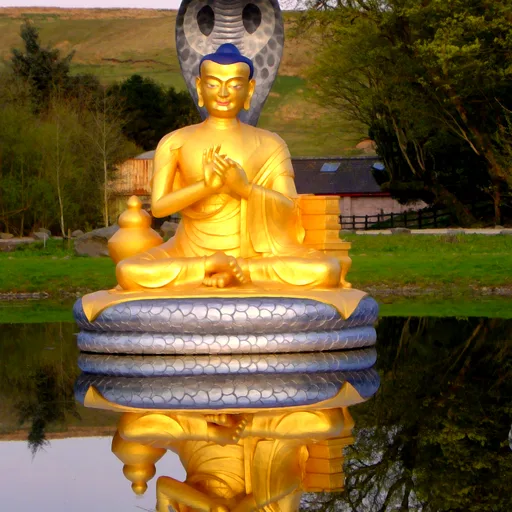
Religious Leaders / buddhism

The Buddha
India -0500-01-0 ~ -0500-01-0
Founder of Buddhism, born as Siddhartha Gautama around the 5th century BCE to the Shakya clan in northern India. He left palace life at twenty-nine, awakened at thirty-five, and taught the Four Noble Truths and the Path.
What You Can Learn
The Buddha's claim that everything we cling to is impermanent, and that suffering arises from grasping, becomes a practical tool for modern information overload and volatility. Treating emotional states as observable phenomena—the technique behind today's mindfulness programs—has been studied for stress reduction and depression relapse prevention, and is embedded in healthcare and corporate training. "Be a lamp unto yourself" translates into intellectual self-reliance: verify claims against primary evidence.
Words That Resonate
All conditioned things are subject to decay; strive on with diligence
Vayadhammā saṅkhārā, appamādena sampādetha
All conditioned things are impermanent
Sabbe saṅkhārā aniccā
Be lamps unto yourselves; take refuge in yourselves, with no other refuge
Atta-dīpā viharatha atta-saraṇā anaññasaraṇā
One is one's own refuge
Attā hi attano nātho
Vigilance is the path to the deathless; heedlessness is the path of death
Appamādo amatapadaṃ, pamādo maccuno padaṃ
Life & Legacy
Siddhartha Gautama, known to history as the Buddha, was born in northern India during a span scholars place between the 7th and 5th centuries BCE, with a death around 400 BCE often cited as one estimate. His father Shuddhodana led a small Shakya republic near present-day Lumbini in Nepal, and his mother Queen Maya died shortly after his birth; he was raised by his aunt Mahapajapati. According to early biographies he lived in luxury, married Yashodhara and had a son Rahula. Encounters with old age, sickness, death and a wandering ascetic prompted him to leave home at twenty-nine in what tradition calls the Great Departure. He studied advanced meditation under two leading teachers, then practiced severe austerities with five companions for six years, but neither path satisfied him. Accepting milk-rice from a village woman named Sujata, he abandoned self-mortification, sat under a pipal tree near Bodh Gaya, and is said to have reached full awakening around thirty-five. What he taught afterward is the Middle Way between indulgence and self-torture, the Four Noble Truths on suffering and its cessation, the Noble Eightfold Path, dependent origination, and the rejection of any permanent self. For forty-five years he walked the Ganges plain teaching kings, merchants, brahmins and outcastes, and eventually accepted women into a formal monastic order at his aunt's request—debated for its limits but striking for its time. His community, the Sangha, organized by conduct rather than hereditary caste, and its sermons survive most fully in the Pali Canon. He faced the schism led by his cousin Devadatta, saw the Shakya homeland destroyed in war, and died at around eighty in Kushinagar according to early texts, telling his disciples to "be lamps unto yourselves." No contemporaneous record exists; surviving accounts are several centuries later, so the line between historical Siddhartha and the figure of devotion remains a matter for careful scholarship.
Expert Perspective
Among founders of world religions, the Buddha is distinctive for placing the religious problem inside human cognition rather than in relation to a creator deity. This lets early Buddhism interface with modern psychology and secular meditation, and it is the historical root of today's mindfulness movement.