Philosophers / Eastern
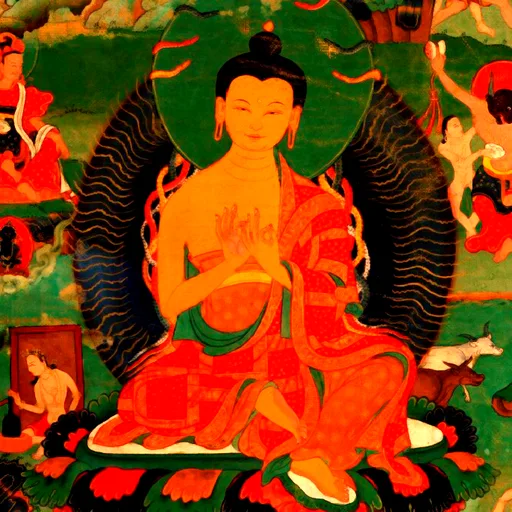
Nagarjuna
0150-01-01 ~ 0250-01-01
Mahayana Buddhist monk and philosopher, 2nd-century South India
Systematized the theory of 'emptiness' and founded the Madhyamaka school
The wisdom of releasing attachment to fixed ideas connects to fearless pivoting in business
A second-century South Indian monk who founded the Madhyamaka school by systematizing the doctrine of emptiness. His Mulamadhyamakakarika is among Buddhism's key texts. Tibetans call him the Second Buddha.
Quotes
Neither ceasing nor arising, neither annihilated nor eternal, neither one nor many, neither coming nor going.
anirodham anutpaadam anucchedam ashaashvatam / anekartham anaanaartham anaagamam anirgamam
What is dependently originated, that we declare to be emptiness. It is a dependent designation; it is itself the middle way.
yaH pratiityasamutpaadaH shuunyataaM taaM pracakSmahe / saa prajNaptir upaadaaya pratipat saiva madhyamaa
Emptiness is declared by the Buddhas to be the exit from all views. But those who hold emptiness as a view are called incurable.
shuunyataa sarvadRSTiinaaM proktaa niHsaraNaM jinaiH / yeSaaM tu shuunyataadRSTis taan asaadhyaan babhaaSire
Emptiness wrongly grasped destroys the slow-witted, like a snake wrongly seized or a spell wrongly cast.
apakarSati shuunyataa durdRSTaa vipascitam / sarpo yathaa durgRhiito vidyaa vaa duSpraSaadhitaa
For whom emptiness works, everything works. For whom emptiness does not work, nothing works.
sarvaM ca yujyate tasya shuunyataa yasya yujyate / sarvaM na yujyate tasya shuunyaM yasya na yujyate
Those who understand that things arise dependently know them to be empty.
yac ca pratiityabhaavanaM bhaavaanaaM shuunyataam viduh
Related Books
Nagarjuna - Search related books on AmazonModern Application
Nagarjuna's denial of fixed essence frees us from clinging to outdated identities. Companies attached to legacy models and individuals who fear career pivots exemplify attachment to svabhava. His two-truths framework models operating on two levels: ultimate awareness that categories are provisional, and conventional rule-following in daily work. The tetralemma teaches us to question the frame of a question itself, stepping outside binaries as a starting point for innovation.
Genre Perspective
Nagarjuna forged the Buddha's teaching of dependent origination into rigorous logic. He addresses being-and-becoming questions raised by Parmenides and Heraclitus while anticipating Kant's unknowable thing-in-itself. His self-negating method prefigures Derrida's deconstruction by eighteen centuries.
Profile
Nagarjuna holds a place in Buddhist thought second only to the Buddha himself. His Madhyamaka system became the unavoidable foundation for every later Mahayana school.
Born around the second century CE to a Brahmin family in South India, he mastered the Abhidharma tradition and then chose to critique it from within. Reliable biographical details are scarce; Chinese sources link him to Nalanda and the Satavahana dynasty, but dates remain debated.
His core project denies svabhava, intrinsic essence. Everything arises through dependent origination; nothing exists independently. This is sunyata, emptiness, which is not nihilism but an affirmation that things appear and function precisely because they lack fixed essence.
The Mulamadhyamakakarika, 27 chapters in verse, examines motion, causation, time, and selfhood using prasanga, or reductio, to show that all metaphysical positions collapse internally. The tetralemma, rejecting existence, non-existence, both, and neither, has drawn interest from analytic philosophers for operating beyond classical logic.
His two-truths doctrine distinguishes conventional truth from ultimate truth. Conventional concepts, though empty, remain tools on the path to awakening. This prevents his philosophy from negating daily life.
Nagarjuna's influence spans India, Tibet, and East Asia. Aryadeva and Chandrakirti continued the school. Tsongkhapa made it central to the Gelug tradition. Kumarajiva's Chinese translations spawned the Three-Treatise school and shaped Tiantai thought. In Japan, Jodo Shinshu venerates him as first of the Seven Patriarchs. He warned that clinging to emptiness as a view is the gravest misunderstanding of all.