Philosophers / Modern Western
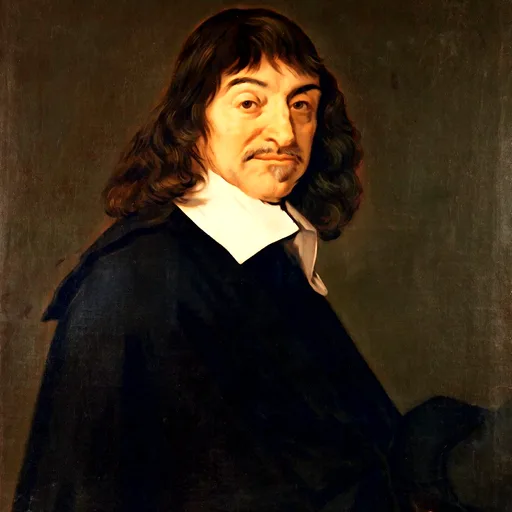
René Descartes
フランス 1596-03-31 ~ 1650-02-11
17th-century French philosopher and mathematician
Established the starting point of modern philosophy with 'I think, therefore I am'
Methodical doubt is the best defense against fake news and cognitive bias
French philosopher-mathematician born in 1596 who launched modern thought with "I think, therefore I am." His methodical doubt rebuilt knowledge on certainty, while his coordinate system fused geometry and algebra.
Quotes
I think, therefore I am.
Cogito, ergo sum.
Good sense is the most evenly distributed thing in the world.
Le bon sens est la chose du monde la mieux partagee.
Once in one's life, everything should be called into doubt.
Illius omnia in dubium revocare semel in vita.
Divide each difficulty into as many parts as possible for a better solution.
Divide chacune des difficultes que j'examinerois, en autant de parcelles qu'il se pourroit, et qu'il seroit requis pour les mieux resoudre.
I think, therefore I am.
Je pense, donc je suis.
Related Books
René Descartes - Search related books on AmazonModern Application
Descartes's methodical doubt is more potent today than when he conceived it. Pausing to ask "Is this actually true?" before accepting a social-media claim is the front line against misinformation. His four rules -- evidence, analysis, synthesis, enumeration -- prefigure modern problem-solving frameworks. His declaration that good sense is universal is a call to judge by reason, not authority. In investing, insisting on personally understood evidence before committing capital is Cartesian rationalism in practice.
Genre Perspective
Descartes founded Continental rationalism, shaping Spinoza and Leibniz while setting the opposition for empiricists like Locke and Hume. He pioneered subject-centered epistemology, proposed mind-body dualism, and through analytic geometry reshaped the foundations of mathematics.
Profile
Rene Descartes dismantled the medieval scholastic worldview and rebuilt philosophy on rational foundations. Born March 31, 1596, in La Haye en Touraine, he lost his mother in infancy and was raised by his grandmother. At the Jesuit college of La Fleche he was allowed to think in bed each morning, a habit that became his lifelong wellspring of insight.
After earning a law degree at Poitiers, Descartes set off to read "the great book of the world." On November 10, 1619, in winter quarters near the Danube, he experienced three revelatory dreams that gave him the vision of a universal method unifying all knowledge.
His method begins with radical doubt: treat anything uncertain as false, then rebuild from what survives. The sole survivor was the thinker's own activity -- "cogito, ergo sum." From this bedrock, Discourse on the Method (1637) and Meditations (1641) reconstructed proof of God and the external world. The Discourse was written in French, deliberately opening learning beyond Latin-reading elites.
Cartesian dualism -- the strict divide between thinking mind and extended matter -- gave science a license to describe nature mathematically, while bequeathing the mind-body problem that still occupies philosophy and neuroscience. In mathematics, his analytic geometry expressed figures as equations, enabling Newton and Leibniz to invent calculus.
In 1649 he accepted Queen Christina's invitation to Stockholm. She demanded 5 a.m. lessons in the Scandinavian cold -- fatal for a lifelong late riser. He died of pneumonia on February 11, 1650, aged 53, yet the rational method he established runs through Spinoza, Leibniz, and Kant into today's scientific practice.