Entrepreneurs / Industrial Pioneer
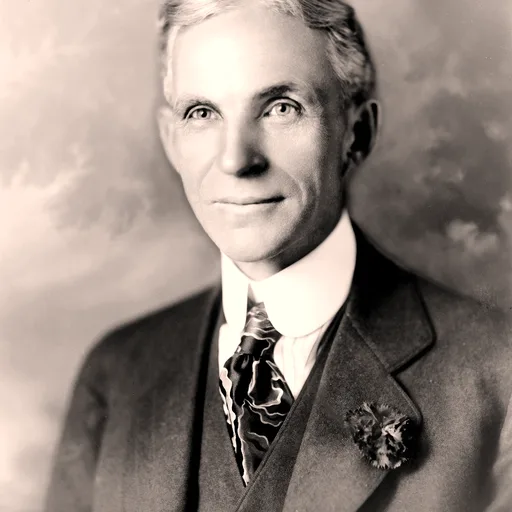
Henry Ford
アメリカ合衆国 1863-07-30 ~ 1947-04-07
Revolutionary of the American automobile industry, 19th-20th century
Established the mass production and mass consumption model with the Model T and moving assembly line
The idea of creating the market itself through disruptive pricing is the prototype of the freemium model
Born on a Michigan farm in 1863, Henry Ford founded Ford Motor and introduced the Model T and assembly line, making cars affordable. His $5-a-day wage turned workers into consumers, creating Fordism.
Quotes
Whether you think you can, or you think you can't -- you're right.
Coming together is a beginning, staying together is progress, and working together is success.
Failure is simply the opportunity to begin again, this time more intelligently.
If I had asked people what they wanted, they would have said faster horses.
Don't find fault, find a remedy; anybody can complain.
A business that makes nothing but money is a poor business.
Related Books
Henry Ford - Search related books on AmazonModern Application
Ford's methods remain instructive. Market creation through price: cutting the Model T's cost built a market that didn't exist, the same logic behind SaaS freemium models. Turning employees into customers: the $5 wage cut turnover and expanded demand, a precursor to stock options and employee discounts. The danger of clinging to success: Ford's attachment to the Model T let rivals overtake him, a warning for founders who stop listening after achieving product-market fit.
Genre Perspective
Ford achieved production and business-model innovation at once. The assembly line served affordability, not just efficiency. The $5 wage and dealer franchises were parallel breakthroughs. Where Carnegie and Rockefeller dominated resources, Ford created demand. His later rigidity is textbook lock-in.
Profile
Ford's achievement was not merely building cars but redesigning how products are made and delivered. His influence extends beyond autos into manufacturing, consumer economics, and labor.
Born near Dearborn, Michigan, Ford was fascinated by machines from childhood. At 16 he left for Detroit and trained as a machinist while studying engines. In the 1890s he worked at Edison Illuminating and built a quadricycle in his spare time. Edison reportedly encouraged him.
Ford Motor launched in 1903 after two prior failures. From those he drew lessons: ship before perfecting, and keep control.
The Model T (1908) was durable, easy to fix, and suited to unpaved roads. The moving assembly line (1913) cut costs so sharply that the price fell from $850 to $260, putting cars within ordinary reach.
In 1914 Ford doubled wages to $5 a day. This attracted talent, slashed turnover, and expanded his customer base. The loop of producers-as-consumers, Fordism, became mass consumption's operating principle.
He pioneered franchise dealerships across six continents and introduced the five-day workweek, recognizing that leisure fuels spending.
Ford's record has blemishes. In the 1920s he published antisemitic material in The Dearborn Independent. His fixation on the Model T let GM seize share with varied models.
He died in 1947 at 83. Most wealth went to the Ford Foundation; the company passed to grandson Henry Ford II. His legacy is mixed, but the architecture of mass production and mass consumption he built remains foundational.