Entrepreneurs / Industrial Pioneer
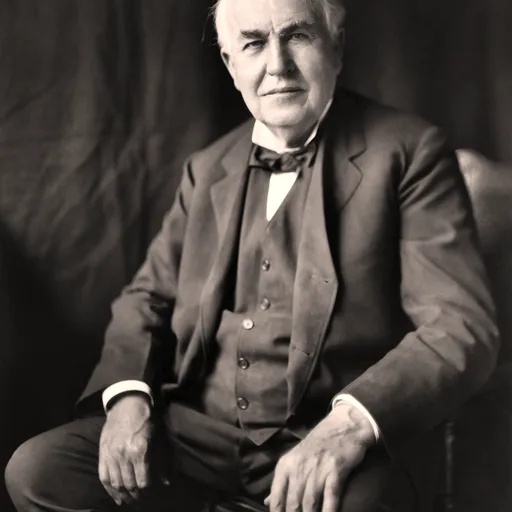
Thomas Edison
アメリカ合衆国 1847-02-11 ~ 1931-10-18
19th-century American inventor and entrepreneur
Commercialized the light bulb and electrical systems and established organized R&D
The perspective of designing the entire ecosystem, not just the product, is the key to business
Born in Ohio in 1847, Edison filed over 1,000 patents and built the first industrial R&D lab at Menlo Park. He commercialized complete systems from phonograph to electric power, founding GE's predecessor along the way.
Quotes
Genius is one percent inspiration and ninety-nine percent perspiration.
I have not failed. I've just found 10,000 ways that won't work.
Our greatest weakness lies in giving up. The most certain way to succeed is always to try just one more time.
There is no substitute for hard work.
I never did anything by accident, nor did any of my inventions come by accident; they came by work.
Opportunity is missed by most people because it is dressed in overalls and looks like work.
Related Books
Thomas Edison - Search related books on AmazonModern Application
Edison offers three lessons for founders. First, design ecosystems, not products: he sold lighting as a complete service, as SaaS companies bundle hardware with subscriptions today. Second, build cross-functional teams early: Menlo Park's mix of specialists is the template for agile squads. Third, the War of Currents warns against technical debt: clinging to a winning technology after the market has moved is fatal. Edison's blend of achievement and misstep makes a living textbook for entrepreneurs.
Genre Perspective
Edison vertically integrated invention, patents, funding, manufacturing, and sales. Where Carnegie and Rockefeller dominated existing industries, he created markets from scratch. His Menlo Park R&D model outweighs any single patent, placing him at the origin of Silicon Valley innovation.
Profile
Edison's legacy is not any single invention but the system for turning invention into industry. He pioneered organized R&D, linked technology to capital markets, and sold complete solutions rather than isolated devices.
Born in Milan, Ohio, he had almost no formal schooling. Scarlet fever impaired his hearing; teachers called him slow. His mother educated him at home, and he read voraciously. At 12 he sold papers on trains and built a railcar lab. At 16 he became a telegraph operator, tinkering with improvements that yielded his first patents.
In 1876 he set up Menlo Park, the first industrial research lab. Chemists, machinists, and glassblowers worked as a team. The phonograph emerged from days of focused effort. For the bulb, thousands of filament trials were run. Crucially, he did not sell bulbs alone: generators, wiring, meters, and sockets were designed together. Commercial power flowed from Pearl Street Station in 1882.
Backed by J.P. Morgan, he founded Edison General Electric and started 14 companies total. Inventor, patent strategist, fundraiser, and marketer in one, he embodied the prototype of the technical entrepreneur.
His method was radical experimentalism: maximize failure speed to converge on success. Silicon Valley later called this fail fast. Yet his fixation on direct current over Tesla's AC in the War of Currents shows how success can blind an innovator. He lost the power industry but kept entering new fields.
By his death in 1931 at 84, he held 1,093 U.S. patents. His greatest invention was the invention factory itself. Menlo Park's model passed to Bell Labs and Xerox PARC, forming the backbone of modern innovation.