Entrepreneurs / Manufacturing
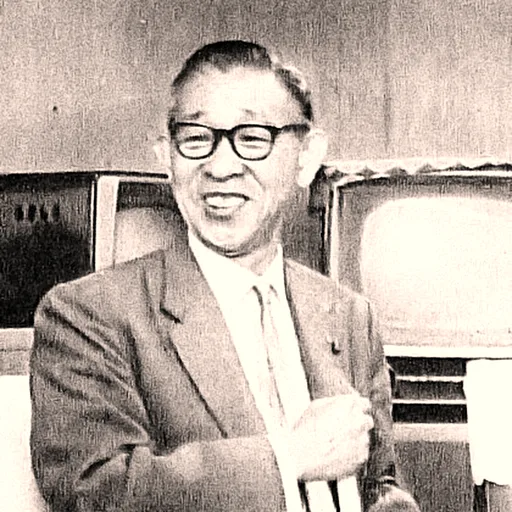
Kōnosuke Matsushita
日本 1894-11-27 ~ 1989-04-27
Meiji-Showa era industrialist and management thinker
Built Panasonic into a global enterprise and was called 'the God of Management'
The 'tap water philosophy' is the intellectual prototype of the freemium model
Konosuke Matsushita (1894-1989), Japan's God of Management, left school at nine and built Panasonic into a global giant. He pioneered divisional structure, affordable-quality pricing, and systematic leader development.
Quotes
The manufacturer's mission is to overcome poverty by producing goods in such abundance that they become as plentiful and cheap as tap water.
産業人の使命は貧䭏の克服である。その為には、物資の生産に次ぐ生産を以て、富を増大しなければならない。水道の水は加工され価あるものであるが、通行人がこれを飲んでもとがめられない。それは量が多く、価格があまりにも安いからである。産業人の使命も、水道の水の如く、物資を無尽蔵にたらしめ、無代に等しい価格で提供する事にある。
Never think you have exhausted every option. Stand at the cliff's edge, and a fresh wind will surely blow.
万策尽きたと思うな。自ら断崖絶壁の淵にたて。その時はじめて新たなる風は必ず吹く。
A sunao (open) mind sees the truth of things without being trapped by preconceptions.
素直な心とは、何物にもとらわれることなく物事の真実を見る心。
Matsushita Electric is in the business of developing people. We also happen to make electrical products.
松下電器は人をつくるところでございます。あわせて電気器具もつくっております。
Commerce is the art of inspiring customers.
商売とは、感動を与えることである。
It only becomes failure when you stop. Keep going until you succeed, and it becomes success.
失敗したところでやめてしまうから失敗になる。成功するところまで続ければそれは成功になる。
Related Books
Kōnosuke Matsushita - Search related books on AmazonModern Application
Matsushita's tap-water philosophy anticipated freemium and near-zero-marginal-cost models: make quality ubiquitous and cheap. His divisional system, giving each unit autonomous P&L, prefigures self-organizing agile teams. His conviction that developing people comes before making products aligns with the human-capital focus now gaining prominence. For resource-constrained founders, his example proves management innovation can be as transformative as technological invention.
Genre Perspective
Matsushita is a management innovator, not a tech inventor. His tools were systems: divisions, dealer networks, and tap-water philosophy. While Honda attacked markets with engineering, Matsushita maximized organizational capability through collective wisdom, framing the founder-vs-system debate.
Profile
Konosuke Matsushita earned the title 'God of Management' not through technological invention but through managerial innovation. His arc from extreme poverty to the helm of Japan's largest consumer electronics company embodies self-made entrepreneurship and philosophy-driven management.
Born in 1894 in Wakayama Prefecture, Japan, he was one of eight children. After his father lost the family fortune in rice speculation, Konosuke left school at nine and apprenticed at a charcoal-brazier shop in Osaka. He later worked at a bicycle shop and then at Osaka Electric Light, where daily exposure to electrical wiring sparked his ambition.
In 1918, at 23, he and his wife Mumeno and her brother Toshio Iue (later founder of Sanyo) started making an improved lamp socket at home. Early sales were dismal, but a fan-insulator order turned the tide. By the mid-1920s a bullet-shaped bicycle lamp established the brand.
In 1932 Matsushita articulated his 'tap-water philosophy': industry's mission is to overcome poverty by making quality goods as abundant and cheap as tap water. The same year he introduced the divisional system, giving each unit independent profit-and-loss responsibility.
After WWII, Allied occupation authorities briefly barred him from management. Once reinstated he partnered with Philips and drove adoption of televisions, washers, and refrigerators during Japan's high-growth era. His retail network bound maker and dealer into a unified service model.
Later he founded the PHP Institute (Peace and Happiness through Prosperity) in 1946 and in 1979 invested 7 billion yen to create the Matsushita Institute of Government and Management for training political leaders. His book The Path sold over five million copies. He died in April 1989 at 94.