Entrepreneurs / Tech
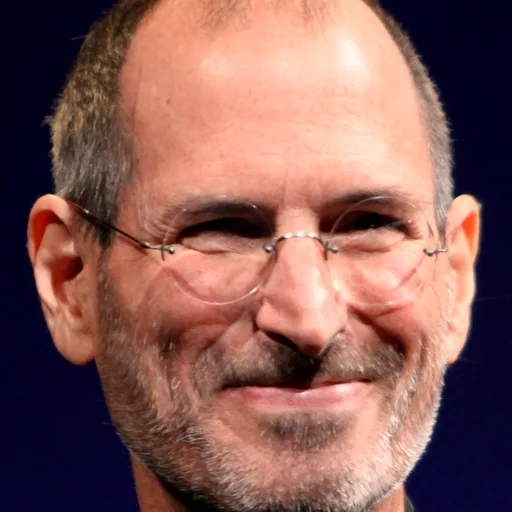
Steve Jobs
アメリカ合衆国 1955-02-24 ~ 2011-10-05
20th-century American technology entrepreneur
Redefined personal computing with the iPhone and Mac
The focus to decide 'what not to do' becomes the ultimate competitive advantage
Steve Jobs (1955-2011) co-founded Apple, was fired, built NeXT and Pixar, then returned to launch iMac, iPod, iPhone, and iPad. He fused technology with liberal arts, redefining consumer electronics as experience design.
Quotes
Stay Hungry. Stay Foolish.
You can't connect the dots looking forward; you can only connect them looking backwards. So you have to trust that the dots will somehow connect in your future.
Design is not just what it looks like and feels like. Design is how it works.
Remembering that you are going to die is the best way I know to avoid the trap of thinking you have something to lose.
Innovation distinguishes between a leader and a follower.
I'm convinced that about half of what separates successful entrepreneurs from unsuccessful ones is pure perseverance.
Technology alone is not enough — it's technology married with liberal arts, married with the humanities, that yields us the results that make our heart sing.
Related Books
Steve Jobs - Search related books on AmazonModern Application
Three Jobs lessons endure. First, ruthless focus: on returning to Apple he cut dozens of products to four, a discipline vital for resource-constrained startups. Second, own the full user experience through vertical integration; even in the SaaS era, companies controlling every touchpoint build stronger brands. Third, his exile-to-comeback arc proves setbacks can become launchpads. NeXT and Pixar were forged by his Apple firing, and both fed directly into Apple's revival.
Genre Perspective
Jobs cast the entrepreneur as consumer-experience designer. Where Carnegie and Rockefeller built infrastructure, Jobs built emotional user bonds. His vertical integration of hardware, software, and services templates modern platform businesses, merging Edison's drive with Disney's storytelling.
Profile
Steve Jobs's mark on technology extends well beyond any product catalog. His career-long question — how can technology transform human experience? — produced answers that reshaped music, communications, film, and publishing.
Adopted as an infant and raised in Los Altos, California, Jobs absorbed mechanical intuition from his machinist foster father. He enrolled at Reed College in 1972 but dropped out after one semester, continuing to audit a calligraphy class that later inspired the Mac's typography. A 1974 India trip and immersion in Zen Buddhism instilled a minimalist design sensibility he carried for life.
In 1976, Jobs and Steve Wozniak founded Apple. The Apple II became one of the first mass-market personal computers. The 1984 Macintosh brought a graphical user interface to consumers, but boardroom politics led to Jobs's ouster in 1985.
Exile sharpened him. At NeXT he built an object-oriented OS that later became Mac OS X. He bought Lucasfilm's graphics division, transforming it into Pixar, whose Toy Story (1995) was the first full-CG animated feature.
When Apple acquired NeXT in 1997, Jobs returned as CEO. He cut the product line to four, relaunched the brand with 'Think Different,' and rolled out the iMac, iPod, iTunes Store, iPhone, and iPad. The 2007 iPhone effectively defined the smartphone era. His vertical integration of hardware, software, and services became the template for modern platform businesses.
Diagnosed with a pancreatic neuroendocrine tumor in 2003, he led iPad development while battling cancer. He died in October 2011 at 56, holding over 450 patents. His legacy: technology married with the humanities yields results that make the heart sing.